
What Is a V-Ring Seal? Features, Benefits, and Applications
A V-ring seal is a simple axial sealing solution commonly used to help protect rotating equipment from dust, dirt, water, oil splash, and other external contaminants. Unlike many shaft seals that are installed inside a housing, a V-ring is mounted directly on the rotating shaft and seals against a stationary counterface.
Its all-rubber construction, flexible sealing lip, and relatively simple installation make it suitable for bearings, motors, pumps, and other rotating equipment. This guide explains how a V-ring works, its structural features, key benefits, material options, and typical applications.
An Overview of the V-Ring Seal
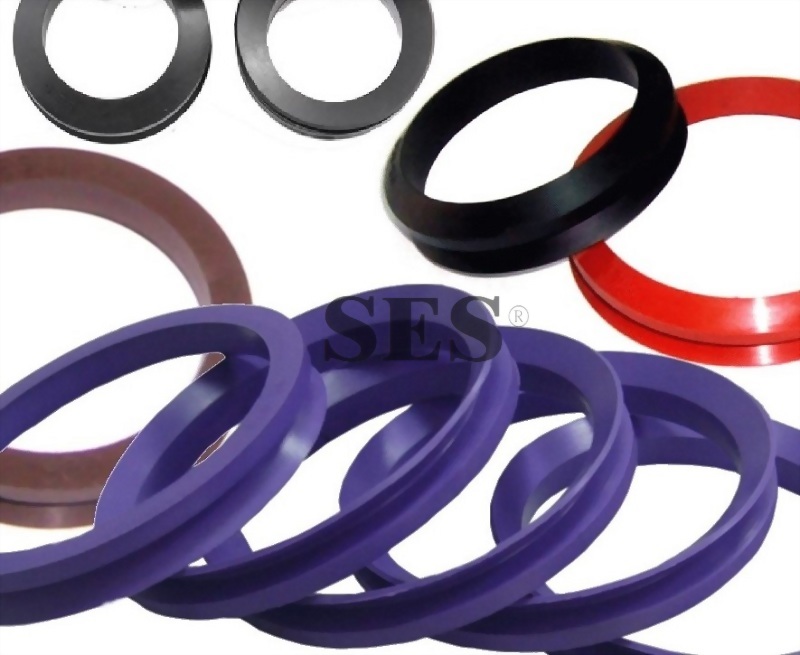
Mounted directly onto a shaft, a V-ring is held firmly in place by natural elasticity. As the shaft turns, the entire seal rotates with it, pressing its flexible lip against a stationary counterface perpendicular to the shaft—such as a bearing face, washer, housing, or metal seal casing.
This axial sealing mechanism allows the V-ring to serve primarily as a dynamic barrier, slinging away dust, dirt, and water splash before contaminants can reach critical components. Depending on system requirements, it can also assist in grease retention.
Because it operates on the shaft's exterior, a V-ring functions effectively as either a primary standalone shield or an auxiliary secondary seal. Positioned outside a conventional radial oil seal, for example, it blocks bulk debris from reaching the primary sealing lip, significantly extending component life in harsh, exposed environments.
Structural Features of the V-Ring Seal
The relatively simple appearance of a V-ring conceals several functional design elements. Its performance depends on how the rubber body, flexible lip, and shaft fit work together.
One-Piece All-Rubber Construction
A V-ring is normally manufactured entirely from elastomer without fabric or metal reinforcement. This gives the seal enough elasticity to stretch over the shaft during installation and remain in position through interference between the seal body and shaft.
This construction can simplify installation because the V-ring does not normally require a dedicated housing bore. Depending on its size and surrounding components, it may also be stretched over flanges, pulleys, or bearing housings during installation.
The practical benefit is greater flexibility when designing or maintaining equipment where machining an additional seal housing would be undesirable.
Flexible Axial Sealing Lip
The distinguishing feature of a V-ring seal is its thin, flexible lip. Rather than sealing radially against the shaft, the lip contacts a stationary counterface in the axial direction.
The lip applies relatively light contact pressure to the counterface. This helps maintain sealing while keeping friction and heat generation comparatively low. In appropriate low-speed applications, V-rings may even operate without lubrication at the sealing interface.
As rotational speed increases, centrifugal force can reduce the lip contact pressure. Actual suitability therefore depends on seal dimensions, shaft speed, installation width, compound, and application conditions.
Elastic Fit Across a Range of Shaft Diameters
The elasticity of the rubber body allows each V-ring size to accommodate a defined range of shaft diameters. This can make selection and replacement more flexible than designs requiring a highly specific housing geometry.
The flexible lip can also accommodate some shaft eccentricity, axial movement, or misalignment relative to the counterface. However, allowable movement depends on seal size, profile, operating speed, and installation conditions, so dimensional guidance should still be confirmed during product selection.
Why Use a V-Ring Seal?
A V-ring is particularly useful when the objective is to add external contaminant protection to a rotating shaft without introducing a complicated sealing assembly.
Simple Installation
Because the seal stretches directly onto the shaft, installation generally does not require a separate machined housing. This can simplify assembly and, in some applications, replacement work.
For larger equipment, certain V-ring designs can also be supplied as cut rings and joined on site, reducing the need to dismantle large surrounding components. The suitability of this method should be determined based on the seal size and application requirements.
Relatively Low Friction
The flexible sealing lip uses comparatively light pressure against the counterface. This helps limit frictional losses and heat generation compared with sealing arrangements that rely on heavier contact pressure.
Low friction can be valuable in motors, bearings, and rotating equipment where unnecessary drag is undesirable. However, operating speed and installation dimensions should remain within the recommended range for the selected V-ring.
Reliable Protection Against External Contamination
One of the main reasons to use a V-ring seal is to help exclude contaminants such as dust, dirt, water splash, oil, or grease from a bearing area or other protected component.
The rotating V-ring also acts partly as a flinger, helping direct contaminants away from the sealing interface. This can make it useful in equipment exposed to environmental contamination.
Useful as a Secondary Seal
A V-ring does not always need to be the primary sealing element. It can be installed outside another shaft seal to provide an additional barrier against contamination. This arrangement can be useful where the primary seal is responsible for retaining lubricant or process media while the V-ring helps reduce external contamination reaching that seal.
For buyers, this means V-rings can be considered both as individual seals and as part of a broader sealing system.
Choosing the Right Rubber Compound for V-Ring Seals
Material selection can influence wear resistance, temperature capability, chemical compatibility, elasticity, and service life. The appropriate compound should therefore be selected according to the actual operating environment rather than by seal dimensions alone.
NBR for General Industrial Applications
Nitrile rubber (NBR) is one of the most commonly selected V-ring materials. It provides a practical combination of oil resistance, wear resistance, elasticity, and general mechanical performance, making it suitable for many standard industrial applications. Specially formulated NBR is one of the most commonly selected materials for V-ring seals, particularly for general applications that require low friction or improved ozone resistance.
Typical applications can include grease-lubricated bearings, electric motors, pumps, machinery, and other equipment operating within the compound's recommended temperature and media conditions.

FKM for Higher Temperatures and Chemical Exposure
When operating temperatures become higher, or the seal is exposed to more chemically aggressive media, fluoroelastomer (FKM) may be considered.
FKM generally provides better resistance to elevated temperatures and a wider range of chemicals than standard NBR. It is often selected for applications above approximately 100°C or where oils, fuels, or other media require greater chemical resistance.
Actual suitability still depends on the specific fluid, temperature, shaft speed, and compound formulation, so material compatibility should be evaluated according to the operating environment rather than temperature alone.
Other Compounds for Specific Environments
V-ring applications vary widely, so NBR and FKM are not the only material options. Other compounds such as EPDM, neoprene, HNBR, and silicone may be considered for specific operating conditions.
For example, EPDM can be suitable where weathering and ozone resistance are important, while HNBR may be considered for selected higher-temperature oil environments. Silicone offers a broad temperature range but has different mechanical and media-resistance characteristics.
Material selection should take into account operating temperature, contact media, shaft speed, expected wear, ozone or weather exposure, and friction requirements. For OEM projects, providing these operating conditions to the seal manufacturer allows the compound to be evaluated according to the actual application.
Common Applications of V-Ring Seals
V-ring seals are used across many types of rotating equipment where contamination protection is required. Bearings are one of the most common applications. A V-ring mounted adjacent to a bearing can help limit the entry of water, dust, dirt, and other contaminants while supporting grease retention.
In electric motors, V-rings may be positioned around rotating shafts to provide additional protection for bearings and internal components, particularly where the equipment is exposed to dirt or moisture.
Pumps and industrial machinery can also use V-rings as external exclusion seals or as secondary protection alongside another primary seal. Similar arrangements are found in gearboxes, conveyors, agricultural equipment, vehicles, and other rotating systems. V-ring technology is used across applications ranging from motors and vehicles to larger industrial rotating equipment.
The correct design depends on more than the shaft diameter. Buyers should also consider speed, counterface geometry, contaminant type, temperature, media, and available installation space.

Conclusion
A V-ring seal is a compact axial sealing solution for rotating shafts that can help exclude external contaminants while maintaining relatively low friction. Its all-rubber construction, flexible lip, straightforward installation, and ability to complement primary seals make it suitable for a range of bearings, motors, pumps, and industrial equipment.
At Shian Fu Enterprise, we manufacture V-rings in multiple profiles, dimensions, and rubber compounds, including NBR, FKM, EPDM, HNBR, neoprene, and silicone. Our broader capabilities include rubber-compound development, product design, production, inspection, and customized sealing solutions for different OEM requirements.
Buyers can review available profiles and dimensions on our V-Ring product page. For assistance selecting a V-ring according to shaft dimensions, temperature, operating media, or application requirements, contact SES to discuss your project.