
A Guide to Bonded Seal: What It Is and How It Works
A bonded seal is a compact sealing component commonly used around bolts, screws, and threaded fittings where liquid or gas leakage needs to be controlled. By combining a metal washer with an elastomer sealing element, it provides mechanical support and sealing within a single component.
For engineers and procurement teams, selecting the appropriate bonded seal requires consideration of pressure, temperature, media compatibility, connection design, and material selection. This guide explains how bonded seals work, their main advantages, common applications, and what to evaluate when choosing a bonded seal manufacturer.
What Is a Bonded Seal?
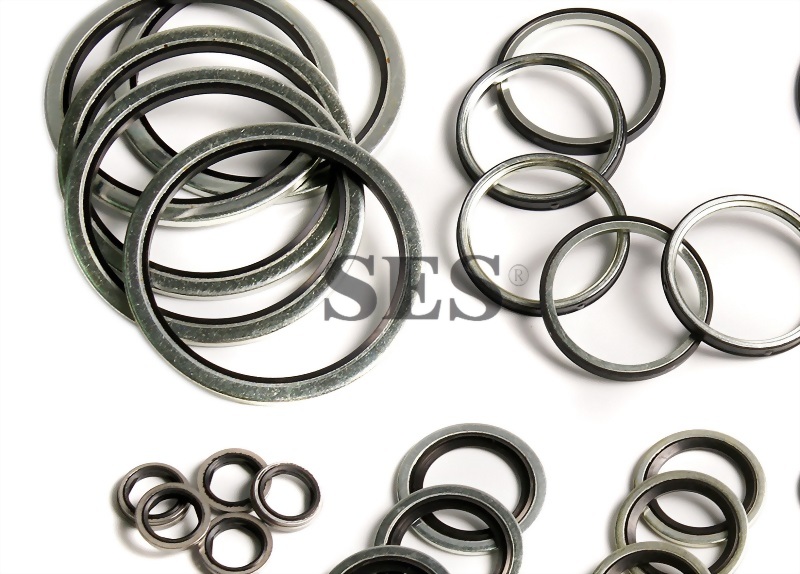
A bonded seal consists of a metal washer combined with an elastomer sealing ring, typically bonded together through a vulcanization process. The seal is generally installed beneath a bolt head, screw, nut, or threaded fitting where the connection requires both clamping and sealing.
The metal portion provides structural support, while the elastomeric portion conforms to the mating surfaces to help close small gaps through which fluid or gas could otherwise escape. This construction allows a bonded seal to perform both functions within one compact component.
Bonded seals are commonly used for static sealing around threaded connections and flange interfaces. They can be found in hydraulic equipment, mechanical engineering, tank and apparatus construction, and other applications involving fluid connections.
Unlike a conventional flat washer, whose primary purpose is usually load distribution, the bonded seal incorporates an elastomer specifically for sealing. It also differs from a standalone O-ring, which normally requires an appropriately designed groove or sealing geometry. The right option depends on the joint design and operating conditions rather than one sealing method being universally preferable.
Different bonded seal designs are available for metric, imperial, and other threaded systems. Self-centering versions can also help position the sealing element around the fastener during installation.
How Does a Bonded Seal Work?
The operating principle of a bonded seal is based on controlled compression. When a bolt or threaded fitting is tightened, the elastomer sealing lip is compressed against the mating surface. Because rubber can deform more readily than the surrounding metal, it can conform to small surface irregularities and help close potential leakage paths.
At the same time, the metal washer supports the connection and limits how much the elastomer can be compressed. This helps reduce the risk of excessive deformation or extrusion that could occur if a rubber sealing element were compressed without sufficient support.
In some bonded seal geometries, internal system pressure can also act against the sealing lip, increasing contact between the elastomer and mating surface. The actual sealing behavior depends on the specific seal profile, installation geometry, pressure, and material.
This interaction between rigid and flexible materials is the key feature of a bonded seal. The washer carries much of the mechanical clamping load, while the elastomer provides the conformability needed for sealing.

Advantages of a Bonded Seal
The advantages of a bonded seal come from the way its metal and elastomer components work together. This combination lets the seal provide mechanical support, controlled compression, and static sealing in a compact form, while supporting a range of installation conditions, pressure requirements, and material options.
Combines Mechanical Support and Sealing
One of the main advantages of a bonded seal is its integrated construction. The metal washer provides rigidity and distributes the clamping force, while the elastomer forms the sealing interface.
For suitable bolt and fitting designs, combining these functions can simplify the assembly compared with managing a separate washer and sealing element. Because the rubber is bonded to the metal component, the two elements also remain together during handling and installation.
Helps Control Compression
Elastomer seals need enough compression to create contact with the mating surface, but excessive deformation can affect their performance.
The thickness and rigidity of the metal washer help limit the compression applied to the elastomer. This provides a more controlled sealing condition when the fastener is tightened. Bonded seal designs are therefore often used where both mechanical fastening and static fluid sealing are required.
The washer does not, however, compensate for incorrect installation in every situation. Appropriate tightening specifications and surface conditions remain necessary.
Supports Different Pressure Requirements
Bonded seals are commonly associated with hydraulic and other pressurized systems because the supported elastomer design can be used around threaded fluid connections.
Their actual pressure capability varies considerably according to seal geometry, dimensions, whether the installation is recessed or non-recessed, elastomer compound, metal construction, and mating surfaces. Pressure ratings should therefore be confirmed for the specific product rather than assumed from the general term “bonded seal.” This makes supplier consultation particularly useful for applications with higher pressure or less conventional connection designs.
Simplifies Assembly
Bonded seals are typically positioned directly beneath a bolt head, fitting, or similar threaded component. They do not necessarily require the separate groove normally associated with many O-ring installations.
Self-centering designs can further assist placement by locating the seal concentrically around the fastener. This can make assembly relatively straightforward for repetitive production, maintenance, and field installation. However, the seal still needs to be correctly matched to the fastener and mating surface.
Supports Multiple Material Combinations
Another practical advantage is the ability to combine different elastomers and metals according to the operating environment. Common elastomers used in bonded seals include NBR, FKM, EPDM, HNBR, silicone, neoprene, and ACM. Metal components may include carbon steel, stainless steel, aluminum, or copper.
Material selection should consider the fluid or gas being sealed, operating temperature, corrosion exposure, pressure, and expected service conditions.
For example, NBR is commonly considered for applications involving mineral oils, while FKM may be evaluated where greater temperature or chemical resistance is required. The correct choice depends on the exact medium and formulation, so compatibility should be confirmed rather than assumed from the generic polymer name.
Applications of Bonded Seals
Bonded seals are used where a threaded or bolted connection also needs to contain a liquid or gas.
Hydraulic Systems
Hydraulic equipment is one of the most common application areas. Bonded seals can be used around hydraulic fittings, manifolds, valves, hose connections, cylinders, and other threaded interfaces. Their compact construction makes them suitable where sealing must occur directly beneath a fitting or fastener.
The combination of metal support and an elastomeric sealing lip can be useful in systems exposed to pressure cycling and regular equipment operation, provided the seal has been selected for the specific pressure and hydraulic fluid.
Pneumatic and Industrial Equipment
Pneumatic machinery also contains threaded connections that must retain compressed air or other gases.
Bonded seals may be used around valves, regulators, fittings, and connection points where static sealing is required. Similar applications occur in industrial machinery, compressors, pumps, process equipment, and fluid-control systems.
Because different industrial environments may involve oil, water, air, chemicals, or combinations of these media, elastomer selection is particularly important.
Automotive Components
Automotive systems contain numerous threaded connections associated with lubrication, hydraulic circuits, braking systems, engines, transmissions, and other fluid-handling components.
A bonded seal may be suitable where the design requires a static seal beneath a fastener or fitting. Automotive applications can also introduce additional requirements related to temperature cycling, oil exposure, vibration, dimensional consistency, and material specifications.

Heavy Machinery and Fluid-Power Equipment
Construction machinery, agricultural equipment, lifting systems, and other fluid-power machinery frequently rely on hydraulic connections.
Because these systems may operate under pressure and in environments exposed to vibration, temperature variation, contamination, or outdoor conditions, seal selection should be based on actual equipment requirements.
In these applications, the bonded seal may be only one part of a broader sealing system. Hose fittings, O-rings, shaft seals, gaskets, and other components may each serve different functions within the same machine.
The Importance of Choosing a Reliable Bonded Seal Manufacturer
Bonded seal performance depends not only on the basic design, but also on dimensional accuracy, elastomer properties, rubber-to-metal bonding, and manufacturing consistency. For OEM buyers, the following factors are worth evaluating when comparing bonded seal manufacturers:
- Application Review Capability: A reliable manufacturer should be able to review key operating conditions such as temperature, pressure, media, fastener dimensions, mating-surface design, and expected production volume. These factors help determine a suitable seal configuration and material combination.
- Material Selection Options: Different applications may require different elastomers, metal washers, hardness levels, surface treatments, or dimensions. A manufacturer that supports multiple material combinations can provide greater flexibility when standard products do not fully match the application.
- Manufacturing and Quality Control: Variations in washer dimensions, rubber geometry, bonding quality, or elastomer properties can affect sealing consistency. Buyers should therefore evaluate how the supplier manages incoming materials, molding or bonding processes, dimensional inspection, batch records, and nonconforming products.
- Customization Capability: When standard metric or imperial sizes are unsuitable, custom bonded seals may be required. The manufacturer should be able to review drawings, confirm tolerances and material requirements, and assess whether a customized design is practical for the intended production volume.
- Technical Communication and Ongoing Support: Supplier capability should not be judged only by the number of sizes available in a catalog. A suitable bonded seal manufacturer should also be able to connect material selection, production control, inspection, and technical communication throughout the project.
Conclusion
A bonded seal combines the rigidity of a metal washer with the conformability of an elastomer sealing element, making it a practical option for many threaded hydraulic, pneumatic, automotive, and industrial connections. Selecting the right design requires consideration of dimensions, pressure, temperature, media, and material compatibility.
At SES, we manufacture bonded seals in multiple standard and self-centering configurations and support different elastomer, metal, and surface-treatment combinations for OEM requirements. Our available materials include NBR, FKM, EPDM, HNBR, silicone, neoprene, and ACM, along with several metal options.
Customers can review our available specifications and seal configurations here.For standard products, customized dimensions, material selection, or OEM application support, contact our team today to discuss your sealing requirements.